BCA (Bachelor of Computer Applications) is a three-year undergraduate degree program designed to launch your career in software development and IT. Unlike B.Tech, it doesn’t require engineering entrance exams. Unlike BSc Computer Science, BCA emphasizes practical coding over theory.
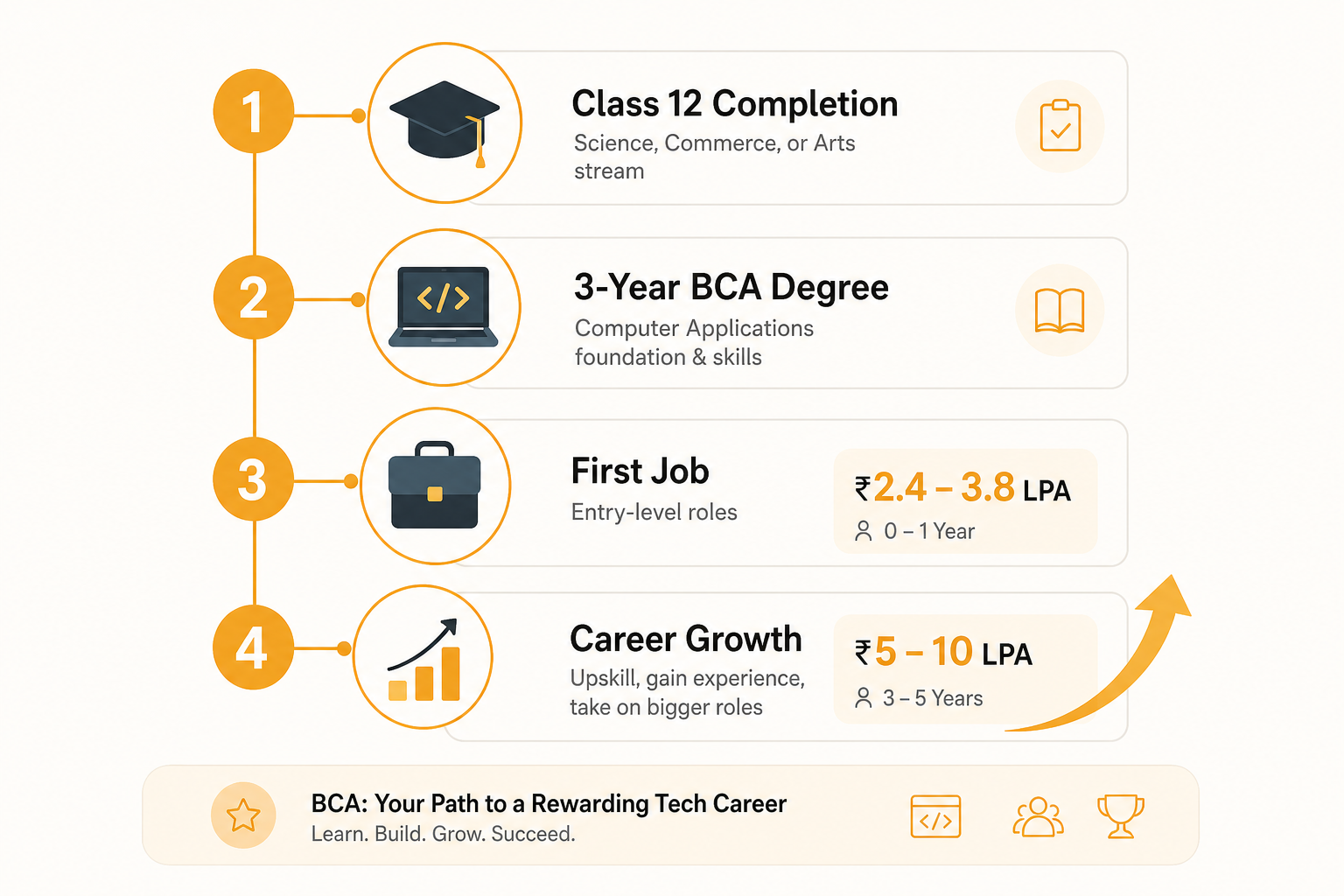
You need 12th pass with 50% marks to apply. Fresher salaries average ₹2.4–3.8 LPA in 2026, growing to ₹5-10 LPA within 3–5 years. Top colleges like Christ University and Loyola College report 90%+ placement rates. If you want to code professionally, enter the job market quickly, and build real software without engineering-level math, BCA is a direct, industry-relevant choice.
What does BCA stand for?
BCA stands for Bachelor of Computer Applications. It’s a focused three-year undergraduate degree program designed specifically to bridge the gap between learning computer science in the classroom and working as a software developer in the real world.
Here’s the key distinction: BCA isn’t about engineering principles or deep mathematics theory. It’s about making you job-ready. The curriculum emphasizes hands-on coding, building real projects, understanding software development workflows, and learning the exact programming languages and tools companies actually use. When you graduate, you’re not just knowledgeable-you’re ready to contribute immediately.
This makes BCA fundamentally different from BSc Computer Science (which leans theoretical) and B.Tech Computer Science (which goes into engineering depth). BCA is the middle path: practical, focused, and direct.
Why Indian students should consider BCA in 2026
The timing for BCA has never been better. Here’s why it’s worth your attention:
The job market is exploding. India’s IT sector continues to grow, and software developers are in high demand. Companies everywhere-from established firms like TCS and Infosys to cutting-edge startups-are hiring BCA graduates aggressively.
The timeline works. Three years to a degree and an entry-level job is faster than B.Tech’s four years. You’re not paying for four years of education, and you’re not waiting as long to start earning.
The entry barrier is low. No entrance exams like JEE. No requirement to have studied Math in class 12 (though it helps). You need 12th pass with 50% marks-that’s genuinely achievable for most students.
The salary progression is solid. Freshers start at ₹2.4–3.8 LPA. Within 3–5 years, you’re earning ₹5-10 LPA. At 5+ years, ₹10-20+ LPA is realistic. Those aren’t abstract numbers-they’re what real BCA graduates are earning right now.
BCA course details: What you’ll actually study
Let’s get concrete. Here’s what a BCA actually is, semester by semester.
Duration and structure
BCA is a 3-year, full-time undergraduate program divided into 6 semesters of 6 months each. It’s AICTE-approved across most Indian universities. Typically, you attend classes 5–6 days a week, work through assignments, and build projects. Most colleges mix lectures with hands-on lab work where you actually sit down and code.
Year 1: Fundamentals (Semesters 1–2)
You’re building the foundation. Core subjects include:
- C and C++ Programming – The gateway languages. You’ll learn data types, loops, functions, object-oriented concepts. This is where students usually either fall in love with coding or realize they need more practice. Both are normal.
- Database Management Systems – How companies store and organize massive amounts of data. You’ll work with SQL, design databases, understand indexing. Boring to describe, genuinely useful in every job.
- Web Development Fundamentals – HTML, CSS, basics of how websites are built. Not fancy yet, just the foundation.
- Discrete Mathematics – Applied math concepts needed for algorithms and computer science. Less calculus, more logic and combinatorics.
- Networking Basics – How computers talk to each other. IP addresses, protocols, the internet’s plumbing.
Year 2: Intermediate (Semesters 3–4)
Now you’re building real confidence.
- Data Structures and Algorithms – This is where programming gets interesting. You learn efficient ways to organize data and solve problems. You’ll use Java or Python. This is heavy, challenging material, but it’s what separates someone who can write code from someone who can write good code.
- Object-Oriented Programming – Deep dive into Java and/or Python. Classes, inheritance, polymorphism-the mental models that underpin modern software.
- Advanced Web Development – JavaScript, React, modern frontend frameworks. You’re building interactive websites, not just static pages.
- Software Engineering – How professional teams build software: planning, design patterns, testing, documentation. The “how to work as a developer” course.
- Database Design – Moving beyond SQL queries to actually designing databases. How do you structure a system so it scales? What are tradeoffs?
Year 3: Specialization (Semesters 5–6)
You’re choosing your direction and diving deep.
- Advanced Programming – Deeper into the languages you’ve chosen, or exploring new ones. Microservices, design patterns, performance optimization.
- Cloud Computing – AWS, Google Cloud, or Azure basics. Where does software actually run? How do companies deploy at scale?
- Cybersecurity – Why hacking happens, how to defend against it, encryption basics. Critical skill in 2026.
- Mobile Application Development – Android and/or iOS development. Building apps people actually use on their phones.
- Final Year Project / Capstone – Usually a semester-long project where you build something real, either solo or in teams. This goes on your resume.
- Electives – Many colleges offer choices here: AI/ML basics, DevOps, UI/UX design, digital marketing technology.
Eligibility to apply for BCA
Here’s what you need:
Basic requirement: Class 12 pass from any recognized board.
Marks: 50% aggregate (some colleges accept 45%). English as a subject helps-most colleges require it, but a few are flexible.
Stream: Math or Computer Science in 12th is ideal, but not mandatory. If you didn’t take Math, most colleges will still admit you. You might need extra support in semesters 1–2 (some colleges offer bridge programs), but it’s absolutely doable.
Entrance exam: Most colleges follow merit-based admission based on your 12th board marks. No major entrance exam required like JEE. Some universities conduct their own entrance tests, but these are generally straightforward.
Age: No strict age limit, but typically you’d enroll within a year or two of finishing 12th.
Admission process: Check the college’s website in June–July (before the academic year starts in August). Apply, submit documents (board marks, ID proof, etc.), and get a merit list. Many colleges also accept direct applications without formal exams if seats are available.
Costs: What will BCA actually cost?
Fees vary widely by college type:
- Government colleges: ₹50,000 – ₹150,000 per year
- Private colleges: ₹150,000 – ₹500,000+ per year
- Deemed universities: ₹200,000 – ₹600,000+ per year
Over three years, you’re looking at anywhere from ₹150,000 (government) to ₹1.8 million+ (premium private colleges). Most students from middle-class families opt for mid-range private colleges (₹200,000 – ₹300,000 per year total), balancing quality and affordability.
Government colleges are cheaper but more competitive to get into. Top private colleges like Christ University and Loyola charge more but have exceptional placements and alumni networks.
Additional costs: textbooks (₹5,000 – ₹10,000), software licenses/courses (often free through college), and internship travel (minimal if done remotely).
Top BCA colleges in India 2026
If you’re serious about BCA, college choice matters-a lot. Here’s where to look:
National leaders:
- Christ University, Bangalore – Consistently ranked #1 for BCA. Strong industry partnerships, 95%+ placement, average package ₹6 LPA+. Fees: ₹350,000+ per year. Alumni include developers at Google, Microsoft, Amazon.
- Loyola College, Chennai – Excellent balance of academics and practical learning. Strong research culture. 92%+ placement, average ₹5–6 LPA. Fees: ₹250,000+ per year.
- Symbiosis Institute of Computer Studies & Research (SICSR), Pune – Rigorous curriculum, advanced labs, excellent for those serious about computer science depth. Slightly lower starting salaries but strong 5-year career trajectories. Fees: ₹400,000+ per year.
Other strong options:
- Kristu Jayanti University, Bangalore
- St. Joseph’s University, Bangalore
- LPU (Lovely Professional University), Punjab – Good balance of quality and affordability, strong online component
- Jain University, Bangalore
- VIT Vellore, Tamil Nadu
Government colleges (if you can get in):
- Delhi University colleges (Delhi College of Arts and Commerce, Ramjas College, etc.)
- Presidency College, Kolkata
- Universities in your state with NAAC accreditation
Selection tip: Don’t just chase the #1 college. Look at placement data, where you want to live, fees your family can afford, and what specializations they offer. A mid-tier college in a city with strong tech presence (Bangalore, Pune, Hyderabad) often beats a top college in a tier-2 city.
Career opportunities after BCA
This is the payoff section. Here’s what actually awaits you.
Job roles and salaries (2026 data)
| Role | Experience | Salary | Key Skills |
|---|---|---|---|
| Software Developer | 0-2 years | ₹6-7 LPA | Java, Python, problem-solving |
| Web Developer | 0-2 years | ₹4-5 LPA | HTML/CSS/JavaScript/React |
| Data Analyst | 0-2 years | ₹5-7 LPA | SQL, Python, Excel, Tableau |
| Full Stack Developer | 2-5 years | ₹8-15 LPA | Frontend + Backend stacks |
| Cybersecurity Analyst | 2-5 years | ₹8-15 LPA | Networking, ethical hacking, security |
| Cloud Engineer | 3-5 years | ₹10-18 LPA | AWS/Azure/GCP, DevOps |
| Machine Learning Engineer | 3+ years | ₹15-25 LPA | Python, TensorFlow, Deep Learning |
Fresher package: What you’ll actually earn walking in
₹2.4 – ₹3.8 LPA is the realistic range for most BCA graduates in 2026. Break that down: roughly ₹20,000–31,000 per month. It’s not a fortune, but it’s a legitimate start.
That said, outliers exist. If you:
- Graduate from a top college (Christ, Loyola, SICSR)
- Have multiple internships under your belt
- Can demonstrate real projects (GitHub portfolio, hackathon wins, contributions to open source)
- Interview well
you can push to ₹5–6 LPA as a fresher. It’s possible, but requires extra effort.
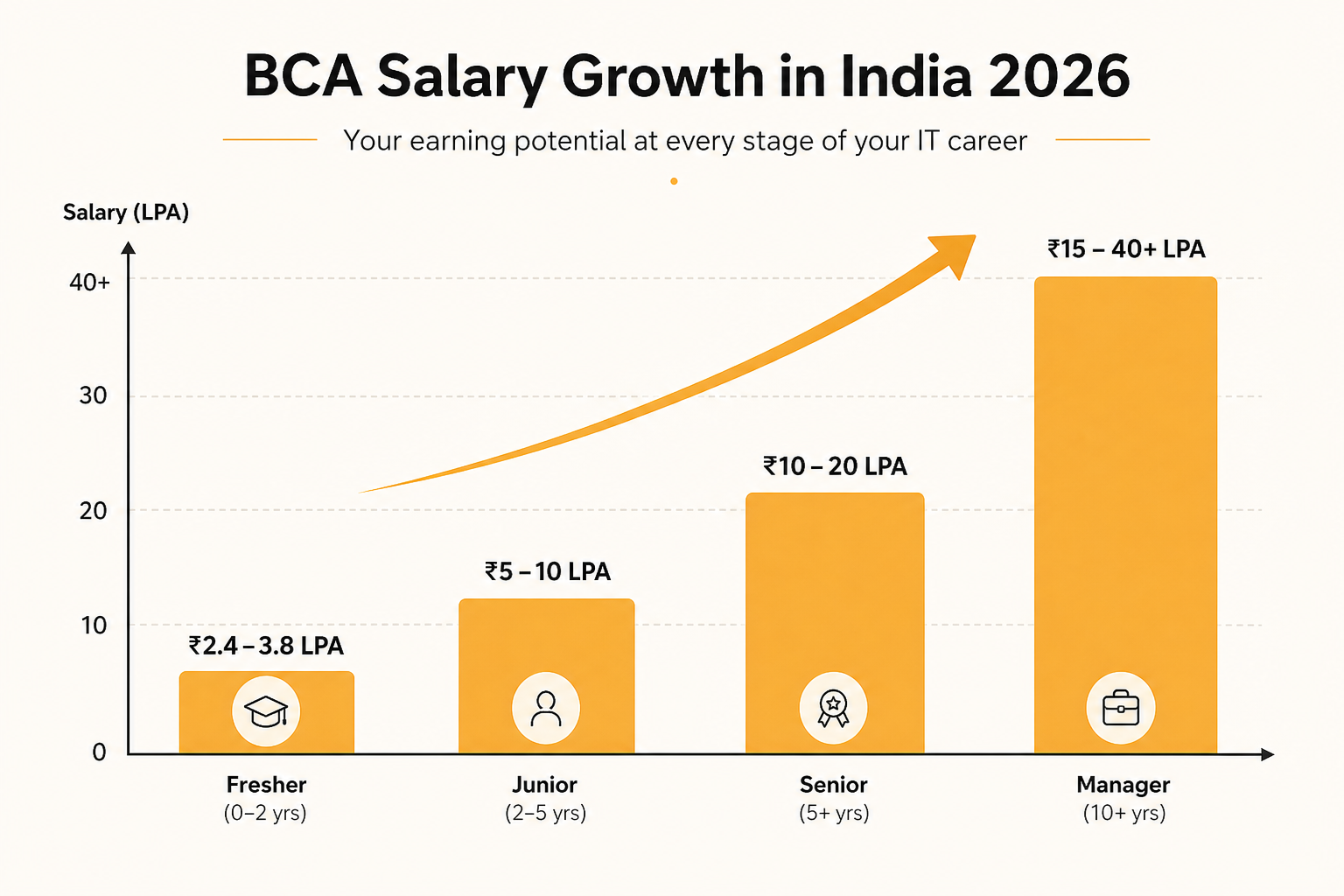
Salary growth: The longer view
Here’s where BCA becomes genuinely attractive:
- Years 0–2 (Fresher): ₹2.4–3.8 LPA. You’re learning on the job.
- Years 2–5 (Junior Developer): ₹5–10 LPA. You’re getting independent project ownership. This jump happens fast if you’re learning well.
- Years 5–10 (Senior Developer): ₹10–20 LPA. Technical depth, mentoring others, architectural decisions.
- Years 10+ (Tech Lead / Manager): ₹20–40+ LPA. Leadership roles, moving toward management or staying deeply technical.
This trajectory is realistic for someone who doesn’t stall. The key: keep learning. Don’t let yourself become the developer who knows one framework really well. The people making ₹20 LPA at 8 years in are constantly picking up new skills.
Top employers hiring BCA graduates
- IT Service Companies: TCS, Infosys, Wipro, HCL, Cognizant, Tech Mahindra. Massive hiring, stable roles, good for first 2–3 years then consider a move.
- Product Companies: Amazon India, Microsoft, Google (limited but real), Adobe, Atlassian. Better learning curve, more challenging work.
- Startups: 100s of well-funded startups in Bangalore, Pune, Mumbai hiring fresh BCA graduates. Higher risk but faster learning and potentially higher equity upside.
- Fintech/BFSI: Zerodha, Paytm, PhonePe, banks’ tech arms. Good salaries, interesting problems.
- E-commerce: Flipkart, Amazon, Unacademy, Meesho. Scale problems, interesting tech.
Higher studies after BCA
You’re not locked into just jobs. Many BCA graduates pursue:
- MCA (Master of Computer Applications): 2-3 year postgraduate degree. Easier entry than M.Tech for BCA graduates. Opens doors to management consulting, startups, research. Average salary post-MCA: ₹8–12 LPA.
- MBA: If you want management/business roles. Less technical, more strategic. Good if you want to move away from pure coding.
- M.Tech in CS/AI: Some universities accept BCA graduates (though B.Tech/BSc CS have advantages). Deep technical specialization.
- Professional certifications: AWS Solutions Architect, Kubernetes, Google Cloud Associate. Cheaper than a master’s, immediately job-relevant.
Many people do BCA, work for 2–3 years, then do MCA while working or full-time. That path works well: you have real experience to bring to postgrad studies.
BCA vs other courses: Which is right for you?
You’re probably weighing options. Let’s be honest about the choices.
BCA vs BSc Computer Science
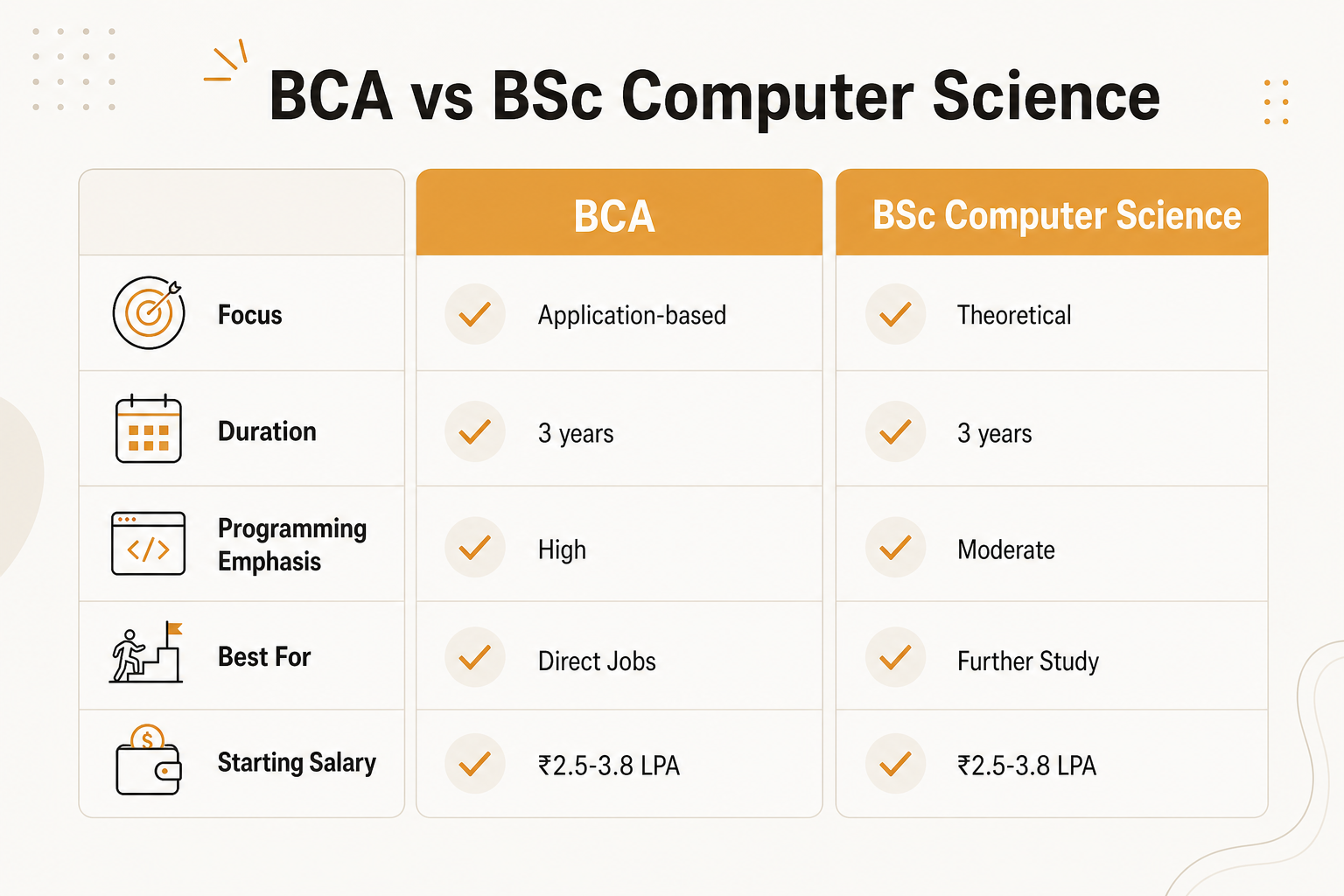
Both are 3-year degrees with similar starting salaries (₹2.5–3.8 LPA). The real difference:
BCA = Application-focused. You spend more time coding, building projects, learning industry-relevant frameworks. Better for: “I want to be a developer and I want to start ASAP.”
BSc CS = Theory-focused. More mathematics, algorithms theory, foundational CS concepts. Better for: “I’m not sure yet” or “I want to do M.Tech or PhD later” or “I prefer understanding deep theory.”
Honest take: If you know you want to code professionally and don’t plan to do M.Tech, BCA is the faster, more direct route. If you’re uncertain or think you might want research/academics later, BSc CS gives more flexibility.
BCA vs B.Tech Computer Science
B.Tech is 4 years, requires clearing JEE/entrance exam, goes deeper into engineering principles. Starting salary is similar (₹3–5 LPA for freshers), but B.Tech graduates often have better options for hardware roles, systems programming, core tech companies.
Choose B.Tech if: You can handle the exam grind, you’re interested in systems/embedded/hardware, or you want absolute certainty of prestige.
Choose BCA if: You want to start 2026 without waiting for exams in 2025, you want to code hands-on immediately, or you prefer to avoid engineering-level math.
Honestly? If you can get into a top B.Tech college, do it-the doors it opens are slightly wider. But if you don’t clear JEE or prefer not to, BCA from a good college is genuinely a strong alternative.
BCA and then MCA vs BSc + M.Tech
Total time: BCA + MCA = 5-6 years (with work in between, you learn real skills). BSc + M.Tech = 5 years (straight through, more theory).
BCA → work 2-3 years → MCA is a solid path many take. You earn money, build real experience, then do MCA with context. That’s often better than doing MCA immediately after BSc.
Why choose BCA? The honest case
Here’s what BCA actually gives you:
1. Direct path to the job market. You’re not trying to “find yourself” for four years. Every semester builds practical skills you’ll use on day one.
2. No exam gatekeeping. JEE is brutal. BCA just needs 12th pass. Yes, it’s more common and less prestigious than a top B.Tech college, but it’s genuinely accessible.
3. Three years, not four. Financially and time-wise, that matters. You’re earning sooner.
4. Real software development. By month 30 of a BCA degree, you’ve built actual projects, touched real codebases, maybe done paid internships. You’re not purely theoretical.
5. The jobs are real. BCA graduates are hired aggressively across India. Startups, product companies, IT services-all want them.
6. The salary is competitive. ₹2.4–3.8 LPA as a fresher isn’t fortune, but it’s respectable. It grows quickly for those who execute well.
7. Optionality stays open. You can do MCA, move into management, pivot to entrepreneurship, keep coding for 20 years, move into AI/ML, whatever. The degree doesn’t lock you into anything.
The downside? Less prestige than a top B.Tech college, and some corporate roles (and PhD paths) are easier with B.Tech. But if you actually want to code for a living starting in 2026, BCA is a direct, sensible choice.
Key takeaways
BCA is the Bachelor of Computer Applications-a focused, practical, three-year degree designed to launch your IT career directly after 12th. You need 12th pass with 50% marks. Most students earn ₹2.4–3.8 LPA as freshers, growing to ₹5-10 LPA within 3–5 years.
Top colleges are Christ University, Loyola College, and SICSR Pune. It’s more practical than BSc Computer Science, faster than B.Tech, and doesn’t require entrance exams. If you’re serious about coding and want to start contributing professionally in 2026, BCA is worth serious consideration.
If you want to know some engineering related full form just use this tool – Full Form Finder for Students

Leave a Reply