
If you’ve been seeing “BA” everywhere — on college brochures, job listings, or your friend’s degree certificate — and wondering what it actually stands for, you’re in the right place.
BA stands for Bachelor of Arts, a three-year undergraduate degree that opens doors across some of the most in-demand fields today.
This guide is for students finishing high school, parents helping their kids pick the right course, and anyone curious about what a BA degree really covers.
Here’s what we’ll break down:
- What BA full form means and the subjects that fall under it
- Who can apply and what the admission process looks like
- Career options and salary potential after you graduate
No fluff — just the straight answers you need to make a smart decision about this degree.
Understanding the Full Form of BA
What BA Stands For in Education
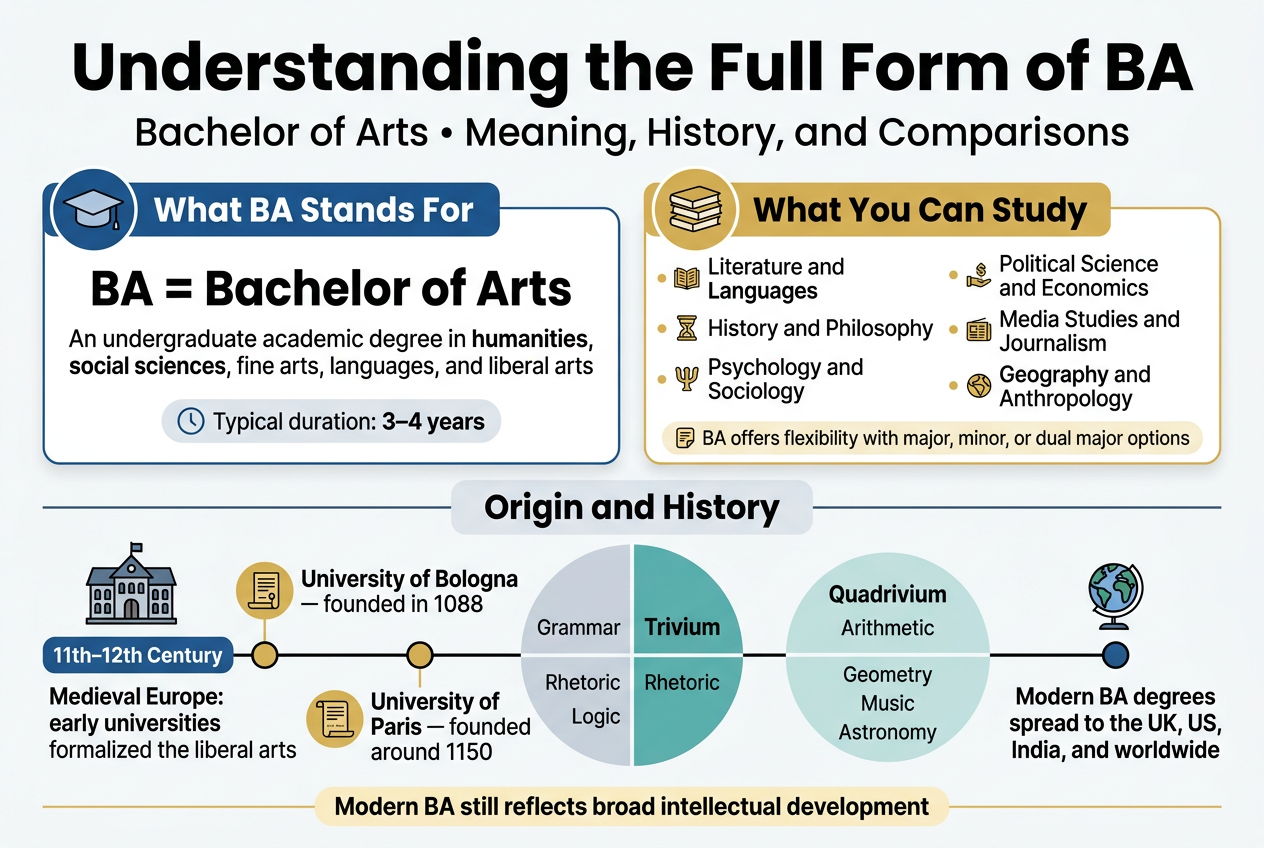
BA stands for Bachelor of Arts. It is an undergraduate academic degree awarded to students who complete a program in the humanities, social sciences, fine arts, languages, or liberal arts disciplines. The degree typically takes three to four years to complete, depending on the country and the specific program structure.
The “Bachelor” part of the title refers to the level of study — it sits right above a diploma or certificate and below a Master’s degree. The “Arts” part does not mean you are limited to painting or music. It covers a broad spectrum of subjects including:
- Literature and Languages
- History and Philosophy
- Psychology and Sociology
- Political Science and Economics
- Media Studies and Journalism
- Geography and Anthropology
A BA degree is one of the most popular undergraduate choices globally because it offers flexibility. Students can shape their academic journey based on their personal interests, career goals, or a mix of both. Many universities allow you to pick a major and a minor, or even combine two subjects under a dual major structure.
Origin and History of the BA Degree
The Bachelor of Arts degree has roots going back to medieval Europe, particularly tied to the rise of universities in the 11th and 12th centuries. Institutions like the University of Bologna (founded in 1088) and the University of Paris (founded around 1150) were among the first to formalize structured academic programs.
At these early universities, education was built around the Trivium and the Quadrivium — two groupings of subjects that formed the foundation of a well-rounded intellectual education.
The Trivium included:
- Grammar
- Rhetoric
- Logic
The Quadrivium included:
- Arithmetic
- Geometry
- Music
- Astronomy
Together, these seven subjects were called the Liberal Arts — the foundation that the modern BA degree still traces itself back to. A student who completed all seven areas of study was considered broadly educated and ready to pursue advanced learning in theology, law, or medicine.
Over centuries, as knowledge expanded and societies changed, universities began adding new subjects and breaking courses into specialized fields. The rigid medieval structure gave way to a more open system where students could choose areas of concentration.
By the 18th and 19th centuries, the BA degree had spread to universities in the United Kingdom, the United States, India, and other parts of the world through colonialism and the expansion of higher education systems. In countries like India, the British model of education heavily influenced how BA programs were set up, which is why three-year BA degrees modeled on British universities became the standard.
Today, the BA degree has evolved to accommodate modern disciplines, but it still carries that same spirit of broad intellectual development that dates back to those early European classrooms.
How BA Differs From Other Degree Abbreviations
When you look at a university’s list of programs, you will come across several abbreviations that can feel confusing at first. Here is a clear breakdown of how BA compares to other common degree titles:
| Degree | Full Form | Primary Focus | Typical Duration |
|---|---|---|---|
| BA | Bachelor of Arts | Humanities, Social Sciences, Languages | 3–4 Years |
| BSc | Bachelor of Science | Sciences, Mathematics, Technology | 3–4 Years |
| BCom | Bachelor of Commerce | Business, Accounting, Finance | 3 Years |
| BBA | Bachelor of Business Administration | Management, Business | 3–4 Years |
| BFA | Bachelor of Fine Arts | Visual Arts, Performing Arts | 3–4 Years |
| BTech / BE | Bachelor of Technology / Engineering | Engineering, Technical Fields | 4 Years |
| LLB | Bachelor of Laws | Law | 3–5 Years |
Key differences to keep in mind:
- BA vs BSc — This is the most common comparison. Both are undergraduate degrees, but a BSc leans heavily on scientific methods, laboratory work, and quantitative reasoning. A BA focuses more on critical thinking, writing, interpretation, and understanding human behavior and society. Someone studying physics or chemistry earns a BSc. Someone studying history or English literature earns a BA.
- BA vs BFA — A BFA is specifically for students who want to pursue creative fields professionally, like painting, sculpture, acting, or dance. A BA in Fine Arts exists too, but it is more academic and less studio or performance-based than a BFA.
- BA vs BBA — A BBA is structured around business management from day one. While a BA in Economics or Sociology might touch on business-related topics, a BBA is a focused, career-oriented degree built around running organizations and managing teams.
- BA vs BCom — A BCom dives into accounting, taxation, finance, and commerce. A BA does not cover these areas unless you specifically choose Economics or Business Studies as your specialization.
The simplest way to think about it: a BA is your go-to degree if you are drawn to subjects that explore people, culture, language, ideas, and society. It gives you room to think broadly, develop strong communication skills, and approach problems from multiple angles — skills that are genuinely valuable across a wide range of careers.
Key Subjects and Specializations Under BA
Humanities and Social Sciences Streams
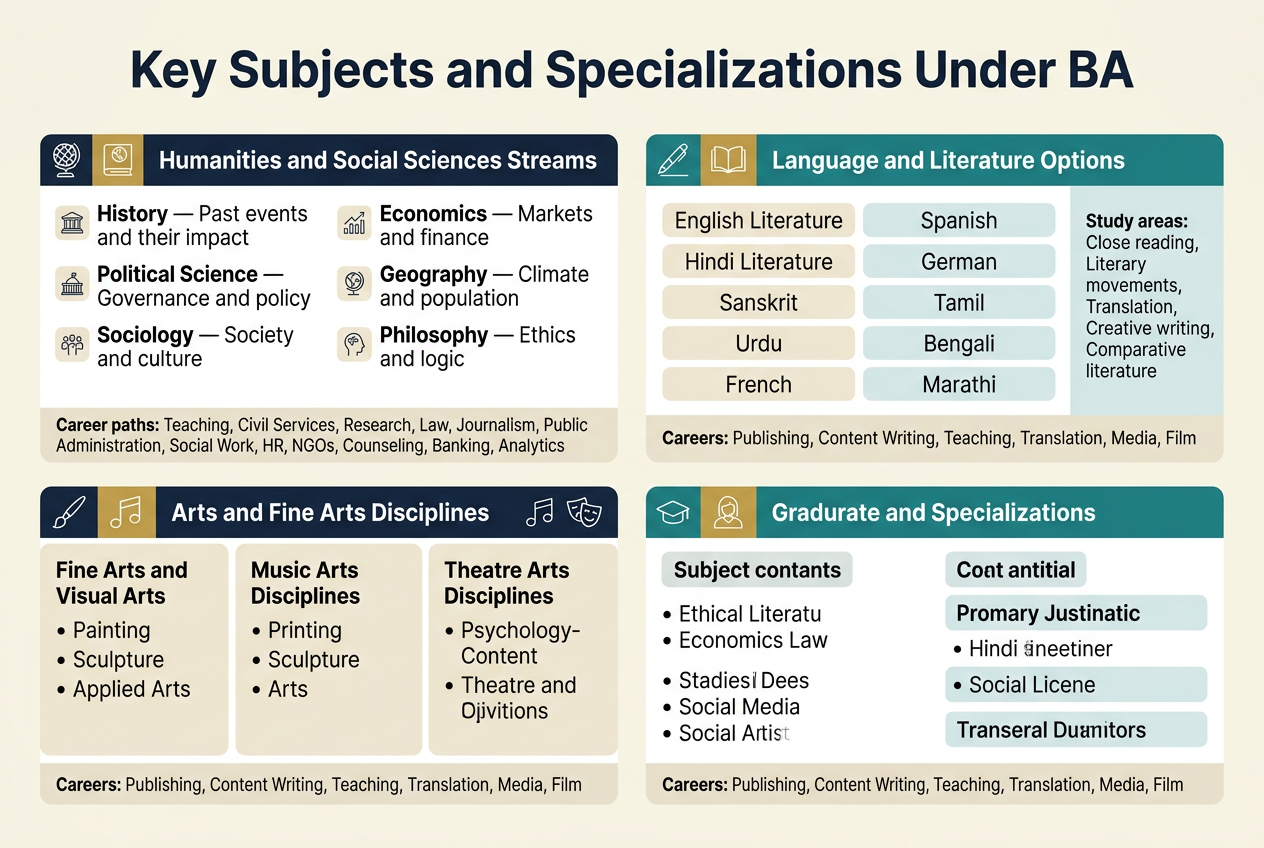
The humanities and social sciences form the backbone of most BA programs. These subjects dig into how humans think, behave, and organize themselves — and honestly, that makes them endlessly fascinating.
Here are some of the most popular streams students choose:
- History – Covers ancient civilizations, colonial periods, world wars, and the political shifts that shaped modern societies
- Political Science – Explores government systems, international relations, public policy, and how power works in the real world
- Sociology – Looks at social groups, cultural norms, inequality, and human behavior at a collective level
- Psychology – Dives into the human mind, mental health, behavior patterns, and cognitive processes
- Economics – Focuses on markets, resource allocation, fiscal policies, and how money moves through societies
- Geography – Goes beyond maps to study climate, population patterns, urban development, and environmental issues
- Philosophy – Tackles big questions about existence, ethics, logic, and the nature of knowledge
| Subject | Key Focus Area | Popular Career Paths |
|---|---|---|
| History | Past events and their impact | Teaching, Civil Services, Research |
| Political Science | Governance and policy | Law, Journalism, Public Administration |
| Sociology | Society and culture | Social Work, HR, NGOs |
| Psychology | Mind and behavior | Counseling, HR, Mental Health |
| Economics | Markets and finance | Banking, Civil Services, Analytics |
| Philosophy | Ethics and logic | Law, Academia, Writing |
Students who pick humanities and social sciences often go on to crack competitive exams like UPSC, pursue law, enter journalism, or build strong academic careers. These subjects develop critical thinking and communication skills that hold up well across almost any profession.
Language and Literature Options
Language and literature specializations are a great pick for students who love reading, writing, and the power of storytelling. BA programs across India and globally offer a wide range of language options — from classical to modern.
Common language and literature specializations include:
- English Literature – One of the most widely pursued BA options, covering poetry, prose, drama, and literary criticism from Shakespeare to contemporary authors
- Hindi Literature – Explores the rich tradition of Hindi poetry, fiction, and drama, from medieval Bhakti poets to modern writers
- Sanskrit – A classical language specialization that connects students to ancient texts, philosophy, and linguistic roots
- Urdu – Covers Urdu poetry, ghazals, and prose, with a strong cultural connection to South Asian heritage
- French, Spanish, German – Foreign language specializations that open doors to translation, tourism, and international careers
- Tamil, Bengali, Marathi, and other regional languages – Strong options for students who want to study regional literary traditions in depth
What you actually study in a language and literature BA:
- Close reading and textual analysis
- History of the language and its evolution
- Major literary movements (Romanticism, Modernism, Realism, etc.)
- Translation theory and practice
- Creative and academic writing
- Comparative literature across cultures
Language and literature graduates are well-suited for careers in publishing, content writing, teaching, translation, media, and the film industry. If you have a way with words, this is a natural fit.
Arts and Fine Arts Disciplines
BA programs in arts and fine arts move away from purely academic subjects and lean into creativity, expression, and craft. These disciplines are seriously underrated when it comes to career potential, especially in today’s creative economy.
Fine Arts and Visual Arts:
- Painting – Traditional and contemporary techniques including watercolor, oil, acrylic, and mixed media
- Sculpture – Three-dimensional art using materials like clay, metal, wood, and stone
- Applied Arts – Design-focused disciplines that blend aesthetics with practical use — think product design, poster art, and commercial illustration
- Art History – A more academic route that studies how art evolved across cultures and centuries
Performing Arts:
- Music – Covers both classical (Hindustani, Carnatic) and contemporary music theory and performance
- Dance – Classical Indian dance forms like Bharatanatyam, Kathak, Odissi, as well as modern and contemporary dance styles
- Theatre and Drama – Stage performance, direction, scriptwriting, and production design
Visual Communication and Design:
Some BA programs now blend traditional arts with design thinking, offering specializations in:
- Graphic design
- Photography
- Film and video production
- Animation (foundational studies)
A degree in arts and fine arts can lead to careers as a professional artist, art teacher, curator, designer, animator, art director, or performer. The creative industry is growing fast, and trained artists are in genuine demand across advertising, entertainment, and digital media.
Emerging BA Specializations in Modern Education
Education has changed a lot in the last decade, and BA programs have kept up. Universities are now offering specializations that didn’t even exist 20 years ago — built around what the job market actually needs right now.
Some of the most exciting emerging specializations:
- BA in Journalism and Mass Communication – Covers news writing, media production, digital journalism, and broadcasting. A solid foundation for anyone wanting to work in media, PR, or content creation.
- BA in Digital Media and Communication – Goes deeper into online platforms, social media strategy, digital storytelling, and multimedia content
- BA in Psychology (Applied) – More career-oriented versions of psychology that focus on counseling techniques, organizational behavior, and mental health awareness
- BA in Development Studies – Focuses on poverty, sustainability, public health, and global development — great for people who want to work with NGOs or in international policy
- BA in Criminology – Combines sociology, law, and psychology to study crime, criminal behavior, and justice systems
- BA in Liberal Arts – A broad, flexible degree that lets students mix subjects across disciplines — increasingly popular at private and international universities
- BA in Culinary Arts – Emerging in some institutions, this blends cultural studies with the craft of food and gastronomy
- BA in Entrepreneurship and Innovation – A newer offering that bridges social sciences with business thinking, helping students build ventures grounded in human-centered approaches
| Emerging Specialization | Best For | Growing Industries |
|---|---|---|
| Digital Media | Content creators, influencers | Media, Marketing, Tech |
| Criminology | Aspiring police, lawyers, researchers | Law, Public Safety |
| Development Studies | Social change-makers | NGOs, International Aid |
| Liberal Arts | Multi-disciplinary thinkers | Consulting, Startups, Policy |
| Applied Psychology | Counselors, HR professionals | Healthcare, Corporate Sector |
| Journalism and Mass Comm | Writers, anchors, journalists | News, PR, Digital Media |
These newer BA paths are designed to make graduates job-ready without losing the depth and critical thinking that a traditional arts education provides. Many of these programs also include internships, live projects, and industry collaborations — making the learning much more hands-on than the older lecture-heavy formats.
Eligibility and Admission Requirements for BA
Academic Qualifications Needed to Enroll
Getting into a BA program is pretty straightforward when it comes to the basic academic requirements. Here’s what you typically need:
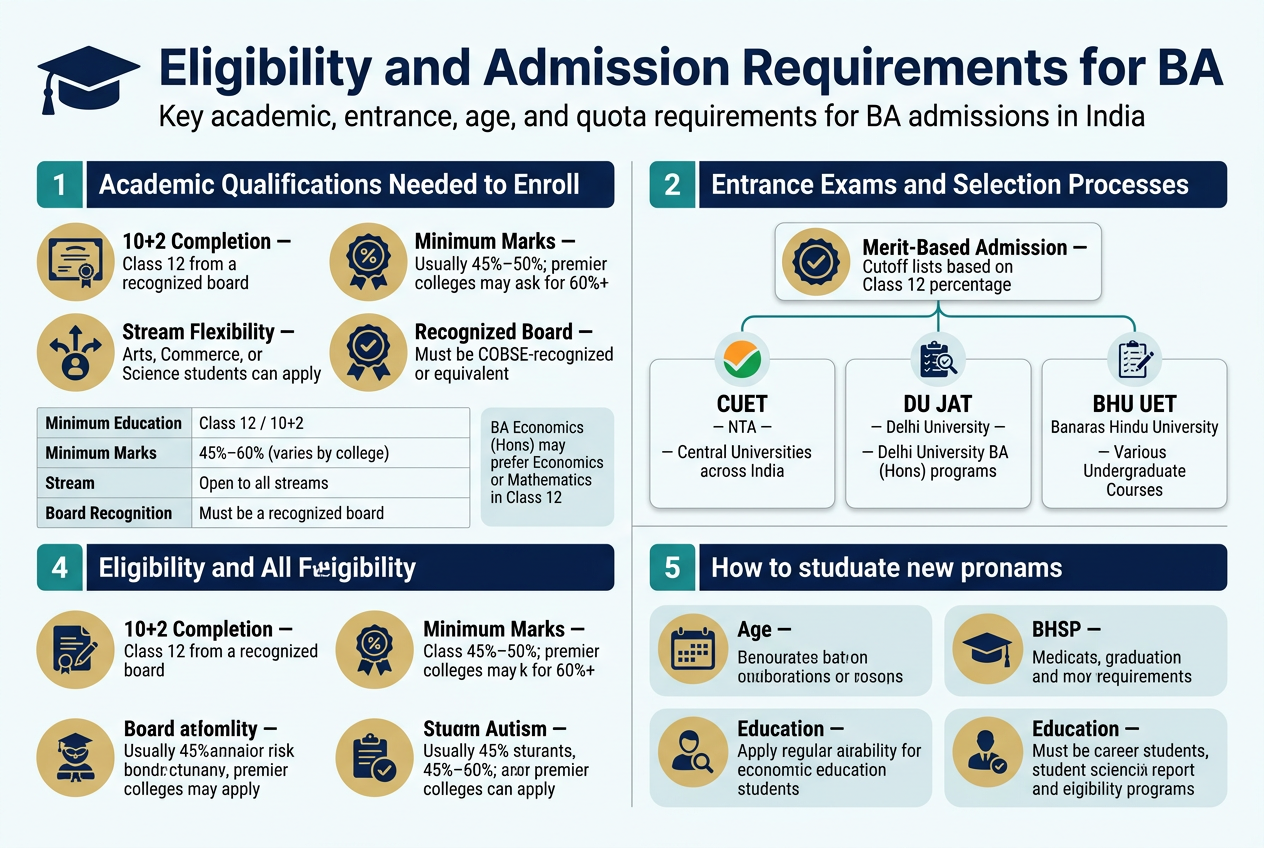
- 10+2 Completion: You must have finished your Class 12 (Higher Secondary) from a recognized board — CBSE, ICSE, or any state board counts.
- Minimum Percentage: Most colleges ask for at least 45% to 50% aggregate marks in Class 12. Premier institutions like Delhi University or Jawaharlal Nehru University may set the bar higher, sometimes requiring 60% or above.
- Stream Flexibility: Unlike engineering or medical courses, BA programs are open to students from any stream — Arts, Commerce, or even Science. So if you studied PCM in Class 12 and want to switch to History or Political Science, you’re welcome to do so.
- Recognized Board: Your Class 12 must be from a board recognized by COBSE (Council of Boards of School Education) or its equivalent.
| Requirement | Details |
|---|---|
| Minimum Education | Class 12 / 10+2 |
| Minimum Marks | 45%–60% (varies by college) |
| Stream | Open to all streams |
| Board Recognition | Must be a recognized board |
Some colleges may also look at specific subject combinations. For instance, if you’re applying for BA Economics (Honours), having Economics or Mathematics in Class 12 can give you a solid edge.
Entrance Exams and Selection Processes
The admission process for BA programs varies widely across India. Some colleges simply go by merit (your Class 12 marks), while others run their own entrance exams or accept scores from centralized tests.
Merit-Based Admission
Many state universities and affiliated colleges admit students purely based on their Class 12 percentage. They release a cutoff list, and if your score clears the cutoff for your chosen subject, you get a seat. Simple as that.
Common Entrance Tests for BA
| Exam | Conducted By | Notable Colleges Accepting It |
|---|---|---|
| CUET (Common University Entrance Test) | NTA | Central Universities across India |
| DU JAT | Delhi University | Delhi University BA (Hons) programs |
| BHU UET | Banaras Hindu University | BHU BA programs |
| GGSIPU CET | Guru Gobind Singh Indraprastha University | IP University, Delhi |
| Symbiosis Entrance Test (SET) | Symbiosis International | Symbiosis colleges |
| Christ University Entrance Test | Christ University | Christ University, Bangalore |
CUET — The Big One Right Now
Since 2022, CUET has become the primary gateway for admissions to most Central Universities in India. It tests you on:
- Section 1A/1B: Language proficiency
- Section 2: Domain-specific subjects (like History, Political Science, Economics)
- Section 3: General Test (logical reasoning, general knowledge, quantitative skills)
Your CUET score, combined with Class 12 marks in some cases, determines your rank and eligibility for seat allocation.
Private Universities
Private colleges like Ashoka University, Flame University, and Shiv Nadar University have their own written tests plus personal interviews or group discussions as part of the process. These usually test critical thinking, writing ability, and general awareness rather than rote subject knowledge.
Age and Other Criteria to Consider
While BA programs don’t come with strict age caps like some professional courses, there are still a few things worth keeping in mind.
General Age Guidelines
- Minimum Age: Most universities require candidates to be at least 17 years old at the time of admission.
- No Upper Age Limit: For regular BA programs, there’s generally no maximum age restriction. Open universities like IGNOU specifically cater to adult learners and working professionals without any age bar.
Other Criteria That Matter
- Domicile Requirements: Some state universities reserve a portion of seats for local residents. For example, Rajasthan University may have a domicile quota for students from Rajasthan. Check the specific university’s rules before applying.
- Category-Based Reservations: India’s reservation policy applies to BA admissions too. Seats are reserved for SC, ST, OBC, EWS, and PwD (Persons with Disabilities) candidates as per government norms, with relaxations in cutoff percentages as well. Category Reservation (Typical) SC 15% ST 7.5% OBC (Non-Creamy Layer) 27% EWS 10% PwD 5% (horizontal)
- Gap Year Students: If you’ve taken a gap year or two after Class 12, don’t worry — most universities don’t penalize you for it. You’ll still be eligible as long as your Class 12 qualifications are in order.
- Foreign Nationals and NRI Candidates: Many top universities have a dedicated quota for NRI and foreign students. The process and fee structure may differ, and additional documentation like passport copies or equivalency certificates from AIU (Association of Indian Universities) may be required.
- Physical Requirements: BA programs typically have no physical fitness criteria, making them accessible regardless of physical ability, with appropriate accommodations available for students with disabilities.
Career Opportunities After Completing a BA Degree
Government and Public Sector Jobs for BA Graduates
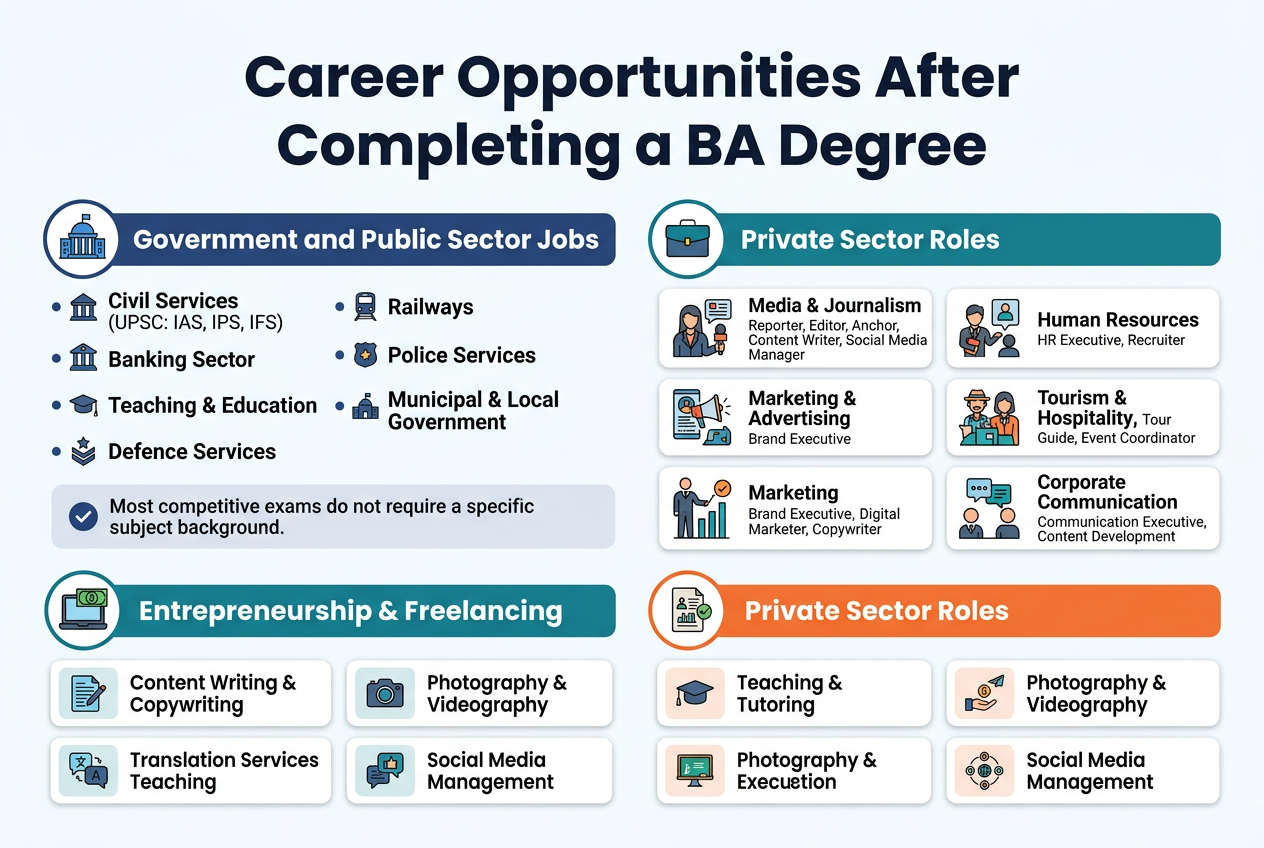
A BA degree opens up a surprisingly wide range of government jobs. Civil services remain one of the most sought-after career paths, and BA graduates are fully eligible to appear for exams like UPSC, SSC, state PSCs, and various other competitive tests. Many students who study History, Political Science, or Sociology find their BA coursework directly aligned with the general studies syllabus of these exams.
Here’s a look at some popular government roles BA graduates can pursue:
- Civil Services (IAS, IPS, IFS) – Through the UPSC examination, BA graduates can aim for some of the most prestigious administrative roles in the country.
- Banking Sector – Public sector banks like SBI and RBI recruit graduates through IBPS and other dedicated exams. Roles include Clerk, Probationary Officer, and Specialist Officer.
- Teaching and Education Department – With a B.Ed after BA, you can apply for government school teaching positions and also appear for TET/CTET exams.
- Defence Services – Positions like NDA, CDS, and various officer-level roles in the Indian Army, Navy, and Air Force are open to BA graduates.
- Railway Recruitment – Indian Railways regularly recruits BA graduates for Group C and Group D positions, as well as administrative roles.
- Police Services – State police recruitment boards accept BA graduates for sub-inspector and constable roles, depending on the state.
- Municipal and Local Government Jobs – Roles in panchayats, urban local bodies, and district administrative offices are also available to BA holders.
The key advantage of a BA degree in the government sector is that most competitive exams don’t require a specific subject background — your degree simply makes you eligible, and then your preparation determines your success.
Private Sector Roles Suited for BA Holders
The private sector offers a wider variety of opportunities than many BA graduates realize. The misconception that BA leads only to “soft” or low-paying jobs is outdated. Companies across industries actively hire arts and humanities graduates because of their communication skills, critical thinking abilities, and adaptability.
Media and Journalism
If you majored in English, Mass Communication, or Journalism, the media industry is a natural fit. Roles include:
- Reporter and Correspondent
- Content Writer and Editor
- News Anchor or Broadcaster
- Social Media Manager
- Copywriter at advertising agencies
Human Resources
HR departments value BA graduates — especially those who studied Psychology or Sociology — because people management is at the core of HR work. Entry-level roles like HR Executive or Recruiter are easily accessible after a BA, and an MBA in HR can fast-track your growth.
Marketing and Advertising
Creative thinkers with a background in languages, literature, or media find marketing roles highly rewarding. You can work as:
- Brand Executive
- Digital Marketing Associate
- Content Strategist
- Market Research Analyst
- Public Relations Officer
Tourism and Hospitality
A BA in Travel and Tourism or Geography directly feeds into roles like:
- Travel Consultant
- Tour Guide
- Event Coordinator
- Hotel Front Desk and Guest Relations Manager
Corporate Communication
Large companies need people who can write well, manage internal communications, and handle client relationships. BA graduates with strong English or communication skills are often preferred for roles in corporate communication, content development, and customer experience.
| Industry | Sample Job Roles | Relevant BA Specialization |
|---|---|---|
| Media | Reporter, Editor, Anchor | Journalism, English, Mass Comm |
| HR | Recruiter, HR Executive | Psychology, Sociology |
| Marketing | Brand Executive, Copywriter | English, Advertising |
| Tourism | Travel Consultant, Guide | Geography, Tourism |
| Corporate | Communication Executive | English, Comm Studies |
| Social Work | Field Officer, NGO Worker | Social Work, Sociology |
Entrepreneurship and Freelancing Paths
One of the most underrated advantages of a BA degree is how well it prepares you for working independently. If you have a creative bent or a specific skill you developed during your degree, entrepreneurship and freelancing can be incredibly rewarding paths.
Freelancing Options for BA Graduates
- Content Writing and Copywriting – Businesses constantly need blog posts, product descriptions, social media content, and email campaigns. BA graduates in English or Journalism are well-positioned to build a strong freelance writing career.
- Translation Services – If you studied foreign languages or regional languages as part of your BA, translation and interpretation services can be a highly paid niche.
- Teaching and Tutoring – Online tutoring platforms like Vedantu, Unacademy, and Chegg actively hire subject matter tutors. You can also independently offer coaching for competitive exams.
- Photography and Videography – BA students studying mass communication or fine arts often develop strong visual skills that translate into a profitable freelance career.
- Social Media Management – Small businesses and individual brands hire freelancers to manage their social media presence, create content calendars, and run paid ads.
Entrepreneurship Paths
- Educational Institutes – Starting a small coaching center or online teaching venture is a natural fit for BA graduates.
- Travel Agency or Tour Planning – Those with a BA in Travel and Tourism can set up boutique travel agencies catering to niche travel experiences.
- Content Agency – If you have a network of writers and editors, building a content marketing agency is a scalable business idea.
- Event Management – BA graduates with organizational skills can get into event planning and management, which is a growing industry in India and globally.
Freelancing doesn’t require a huge investment — just a reliable internet connection, strong skills, and consistency. Platforms like Upwork, Fiverr, Freelancer, and LinkedIn are great starting points.
Higher Education Options to Boost Your Career
A BA degree is a strong foundation, but pairing it with postgraduate education can dramatically increase your earning potential and open doors that would otherwise stay closed. Here are the most popular and impactful options:
Postgraduate Degrees (MA)
A Master of Arts is the most natural progression after a BA. An MA allows you to specialize deeper in your subject and qualifies you for:
- University and college-level teaching (after NET/SET)
- Research positions
- Senior roles in media, public administration, and social work
MBA (Master of Business Administration)
An MBA after BA is one of the most powerful combinations. It shifts your career trajectory toward management and business leadership. Popular specializations include:
- Marketing
- Human Resources
- Finance
- Operations
Many top B-schools like IIMs, XLRI, and FMS accept BA graduates, provided they clear the required entrance exams like CAT, XAT, or SNAP.
Law (LLB)
A 3-year LLB after BA is one of the most respected professional paths. BA graduates with Political Science or English backgrounds often find the transition smooth. Career options include:
- Advocate/Lawyer
- Legal Advisor
- Judicial Services
- Corporate Legal Counsel
Mass Communication and Journalism (PG Diploma / MA)
If your BA was in a different subject but you’re passionate about media, a postgraduate diploma in Mass Communication from institutes like IIMC, Symbiosis, or XIC can give you the skills and credentials to enter the media industry professionally.
Hotel Management (PG Diploma)
BA graduates looking to move into the hospitality sector can pursue short-term or full postgraduate diplomas in Hotel Management to qualify for managerial roles.
Digital Marketing Certifications
Short-term certifications from Google, HubSpot, or Meta (Facebook) in digital marketing take just a few months but can significantly boost your employability in the modern job market.
| Higher Education Path | Duration | Best For |
|---|---|---|
| MA | 2 Years | Teaching, Research, Media |
| MBA | 2 Years | Management, Business Roles |
| LLB | 3 Years | Law and Legal Careers |
| PG Diploma (Mass Comm) | 1 Year | Journalism, Broadcasting |
| Digital Marketing Cert | 3–6 Months | Marketing, Freelancing |
| B.Ed | 2 Years | School Teaching |
Choosing the right path after BA depends on your interests, financial goals, and how much time you’re willing to invest in further studies. The good news is that there’s no shortage of options — a BA degree is genuinely one of the most versatile academic qualifications you can hold.
Top Colleges and Universities Offering BA Programs
Leading Institutions in India for BA Studies
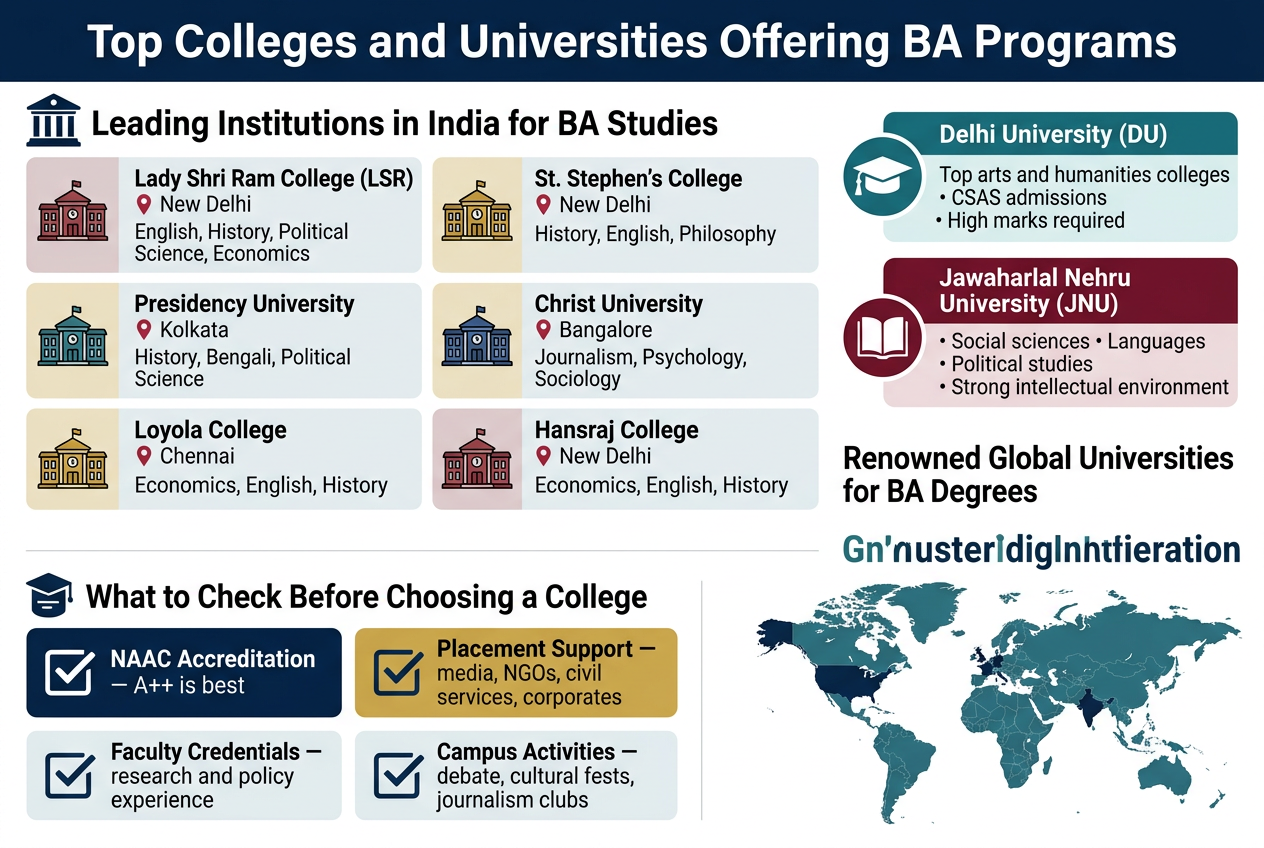
India has some seriously impressive colleges and universities for BA programs, and the competition to get into the top ones is fierce for a good reason. These institutions offer excellent faculty, rich campus culture, and strong alumni networks that can genuinely open doors after graduation.
Here are some of the most respected names across the country:
| Institution | Location | Notable BA Specializations |
|---|---|---|
| Lady Shri Ram College (LSU) | New Delhi | English, History, Political Science, Economics |
| St. Stephen’s College | New Delhi | History, English, Philosophy |
| Presidency University | Kolkata | History, Bengali, Political Science |
| Christ University | Bangalore | Journalism, Psychology, Sociology |
| Loyola College | Chennai | Economics, English, History |
| Fergusson College | Pune | Political Science, Geography, Sociology |
| Miranda House | New Delhi | English, History, Political Science |
| Hansraj College | New Delhi | Economics, English, History |
Delhi University (DU) deserves a special mention because it houses some of the finest arts and humanities colleges in the entire country. Getting into DU’s top colleges through the Common Seat Allocation System (CSAS) requires consistently high marks, and the experience you get there genuinely rivals many international programs.
Jawaharlal Nehru University (JNU) is another powerhouse, especially for students interested in social sciences, languages, and political studies. The intellectual environment there is hard to match anywhere in India.
A few things worth keeping in mind when choosing a college in India:
- NAAC Accreditation: Always check if the institution holds a high NAAC grade (A++ being the best). This reflects the overall quality of the academic environment.
- Placement support: Some BA programs now come with strong career cells that connect students to media, NGOs, civil services coaching, and corporates.
- Faculty credentials: Look at whether professors are actively publishing research or involved in policy work — it makes classroom discussions way richer.
- Campus activities: Debate societies, cultural fests, student journalism clubs — these extracurriculars often shape your career as much as the degree itself.
Renowned Global Universities for BA Degrees
If studying abroad is on your radar, a BA from a globally recognized university carries significant weight across industries worldwide. Many international BA programs are deeply interdisciplinary, letting students mix subjects in ways that are less common in the Indian system.
Here’s a look at some of the world’s top universities for BA programs:
| University | Country | Known For |
|---|---|---|
| University of Oxford | United Kingdom | Philosophy, Politics & Economics (PPE), History |
| Harvard University | USA | Social Sciences, History, Literature |
| University of Cambridge | United Kingdom | English, History, Philosophy |
| Yale University | USA | Humanities, Political Science, Psychology |
| University of Toronto | Canada | Sociology, Philosophy, Linguistics |
| Australian National University | Australia | Asian Studies, Political Science, History |
| London School of Economics (LSE) | United Kingdom | Sociology, Anthropology, Politics |
| University of Edinburgh | Scotland | Philosophy, History, Literature |
Oxford’s PPE (Philosophy, Politics, and Economics) program is arguably one of the most influential BA degrees in the world — a huge number of global leaders, journalists, and economists have gone through it. It’s competitive and demanding, but the return on that investment, both intellectually and professionally, is well recognized.
Liberal Arts programs at American universities like Harvard, Yale, and Stanford give you the flexibility to explore multiple disciplines before declaring a major. This structure works really well for students who aren’t 100% sure which direction they want to go in yet.
A few things to factor in when considering international BA programs:
- Tuition and Scholarships: Programs in the US and UK can be expensive. Look into scholarships like Chevening (UK), Fulbright (USA), or Commonwealth Scholarships before ruling anything out.
- Work Visa Options Post-Study: Countries like Canada, Germany, and Australia offer post-study work visas that make it easier to gain international work experience after graduation.
- Global Alumni Networks: Universities like Oxford and Harvard have alumni clubs in nearly every major city worldwide, which genuinely matters when you’re job hunting.
- Cultural Fit: Beyond rankings, think about whether the teaching style (seminar-based, lecture-heavy, research-focused) matches how you learn best.
Online and Distance Learning BA Programs
Not everyone can pack up and move to a campus — whether it’s financial reasons, family responsibilities, a job, or just personal preference. The good news is that online and distance BA programs have become much more credible and flexible over the past decade, and several top institutions now offer them.
Reputable Distance and Online BA Programs in India
India has a well-established tradition of distance education, largely built around IGNOU (Indira Gandhi National Open University), which happens to be one of the largest open universities in the world by enrollment.
| Institution | Program Type | Popular BA Courses |
|---|---|---|
| IGNOU | Distance Learning | BA in English, History, Political Science, Sociology |
| Symbiosis Centre for Distance Learning (SCDL) | Online/Distance | BA in Liberal Arts, Communication |
| Annamalai University | Distance Learning | BA in Tamil, History, Economics |
| Karnataka State Open University (KSOU) | Distance Learning | BA in multiple humanities disciplines |
| Dr. B.R. Ambedkar Open University | Distance Learning | BA in Social Sciences and Humanities |
IGNOU’s BA program is widely accepted by employers and government bodies across India. Many civil service aspirants pursue it specifically because of the flexibility it offers while they focus on exam preparation.
Global Online BA Programs
International universities have also ramped up their online offerings significantly, especially after 2020. Here are some strong options:
- University of London (Coursera): Offers online BA degrees in Social Sciences in partnership with Coursera. It carries genuine University of London branding and is globally recognized.
- Arizona State University (ASU Online): One of the most highly ranked online universities in the US, offering BA programs in areas like Communication, Sociology, and Liberal Arts.
- Open University (UK): A pioneer in distance learning, offering BA degrees that are fully recognized across Europe and beyond.
- Southern New Hampshire University (SNHU): An affordable and flexible US-based online BA, popular among working professionals.
Key Things to Check Before Enrolling in an Online BA
Choosing an online or distance program requires a bit more due diligence than picking a traditional campus program:
- UGC Recognition (for India): Make sure the university is listed on the UGC’s approved list for distance education programs. Without this, your degree may not be valid for government jobs or higher education admissions.
- Accreditation (for international programs): In the US, check for regional accreditation. In the UK, look for universities listed on the HESA register.
- Course delivery format: Some programs are fully self-paced, while others have live virtual sessions. Knowing which format suits your schedule matters a lot.
- Exam structure: Find out whether exams are conducted online, at designated centers, or through proctored sessions. This affects your planning significantly.
- Alumni reviews: Check platforms like LinkedIn, Reddit communities, and Quora for honest reviews from past students before committing.
Distance and online BA degrees are a practical, legitimate path — especially when you pick the right institution and stay disciplined about your studies.
Salary and Growth Potential for BA Graduates
Entry Level Salary Expectations After BA
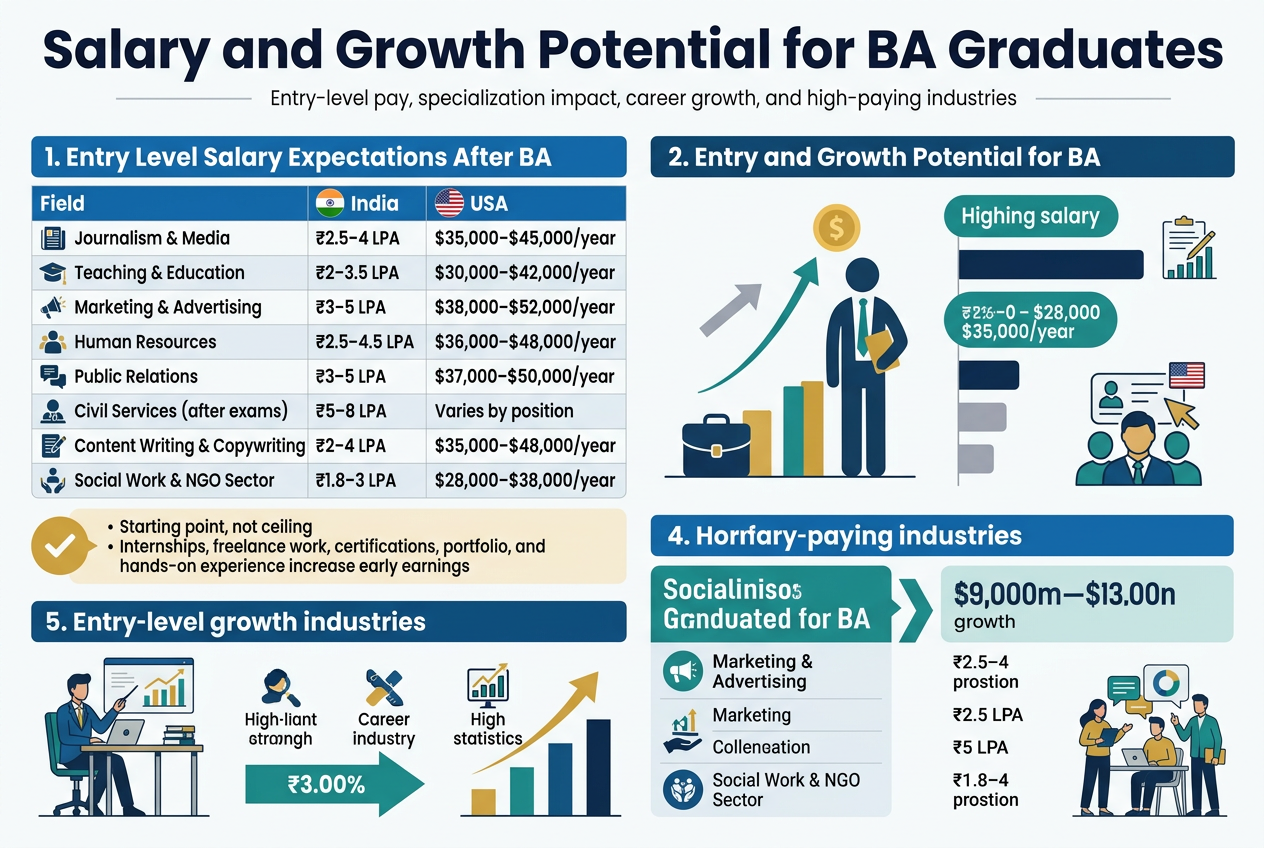
Starting salaries for BA graduates vary quite a bit depending on the field you step into, the city you work in, and the specific skills you bring to the table. Here’s a rough picture of what fresh BA graduates can expect across different career paths:
| Field | Average Starting Salary (India) | Average Starting Salary (USA) |
|---|---|---|
| Journalism & Media | ₹2.5 – 4 LPA | $35,000 – $45,000/year |
| Teaching & Education | ₹2 – 3.5 LPA | $30,000 – $42,000/year |
| Marketing & Advertising | ₹3 – 5 LPA | $38,000 – $52,000/year |
| Human Resources | ₹2.5 – 4.5 LPA | $36,000 – $48,000/year |
| Public Relations | ₹3 – 5 LPA | $37,000 – $50,000/year |
| Civil Services (after exams) | ₹5 – 8 LPA | Varies by position |
| Content Writing & Copywriting | ₹2 – 4 LPA | $35,000 – $48,000/year |
| Social Work & NGO Sector | ₹1.8 – 3 LPA | $28,000 – $38,000/year |
One thing to keep in mind — these are starting points, not ceilings. A lot of BA graduates land decent packages right out of college when they combine their degree with internship experience, freelance work, or certifications. The graduates who hit higher starting salaries almost always have something extra going for them — a strong portfolio, a specialized skill, or prior hands-on experience in their field.
If you’re worried that a BA degree means settling for low pay, it really depends on what you do with the degree. A BA in Economics or Psychology, for example, often opens doors to better-paying entry-level roles compared to a general arts degree. Location matters too — metro cities like Mumbai, Delhi, or Bengaluru in India, or cities like New York and San Francisco in the US, generally offer significantly higher starting packages.
How Specialization Impacts Your Earning Potential
Your specialization under a BA program is probably the single biggest factor that shapes your salary trajectory. Not all BA degrees are treated equally in the job market, and that’s just the reality.
Here’s how different specializations stack up in terms of earning potential:
High-Earning Specializations
- BA Economics – Opens doors to finance, banking, data analysis, and policy roles. Graduates often pursue roles as financial analysts or economic consultants, which pay extremely well.
- BA Psychology – Strong demand in HR, counseling, corporate training, and organizational behavior. With a master’s degree added on, salaries can jump significantly.
- BA English (with strong writing skills) – Content strategy, copywriting, technical writing, and UX writing are booming industries that pay handsomely for skilled writers.
- BA Political Science / International Relations – Ideal for careers in civil services, international organizations, law school preparation, or think tanks.
Moderate-Earning Specializations
- BA Sociology – Works well in social research, NGOs, and HR, though pay can be modest at first.
- BA History – Mostly leads to teaching, research, or heritage-related roles. Earning potential grows with advanced degrees.
- BA Geography – Surprisingly versatile, with opportunities in urban planning, environmental consulting, and GIS roles.
Practical Impact of Specialization
A BA in Economics graduate who joins a financial analytics firm can be making ₹6–8 LPA in India or $55,000+ in the US within just two to three years of working. Compare that to a general BA graduate in a non-specialized field — the gap can be substantial.
The trick is to pair your specialization with real-world skills. A BA Economics student who also learns Python or SQL for data work, or a BA English student who masters SEO and content strategy, will always out-earn someone who only relies on the academic degree itself.
Long Term Career Growth Trends for BA Holders
The long-term picture for BA graduates is actually quite bright — IF they’re strategic about their career path. Early years can feel slow, but the growth curve tends to steepen significantly after the first five years.
Here’s what the career arc typically looks like:
| Career Stage | Years of Experience | Typical Salary Range (India) | Typical Salary Range (USA) |
|---|---|---|---|
| Entry Level | 0 – 2 years | ₹2 – 5 LPA | $30,000 – $50,000 |
| Mid Level | 3 – 6 years | ₹5 – 12 LPA | $50,000 – $80,000 |
| Senior Level | 7 – 12 years | ₹12 – 25 LPA | $80,000 – $120,000 |
| Leadership / Expert | 12+ years | ₹25 LPA+ | $120,000+ |
A few trends that are shaping long-term career growth for BA graduates:
- Rise of digital media and content economy – Writers, journalists, and communication specialists are in huge demand as companies double down on content marketing.
- Mental health awareness driving psychology careers – There’s a global uptick in demand for counselors, therapists, and HR professionals trained in psychology.
- Civil services and government jobs – Competitive but extremely rewarding in terms of job security, perks, and social impact.
- Education technology (EdTech) – BA graduates with teaching inclinations are finding excellent opportunities in online education, curriculum design, and instructional design.
- International development and NGO sector growth – Globally, there’s growing funding for social impact work, making sociology, geography, and political science graduates increasingly valuable.
The graduates who experience the steepest long-term growth are typically those who pursued higher education (MA, MBA, LLB, or professional certifications) alongside building practical experience. Combining a BA with an MBA is one of the most common ways arts graduates catapult into high-paying corporate leadership roles.
Industries Offering the Best Pay for BA Graduates
Not all industries treat BA graduates the same. Some sectors genuinely value the communication, critical thinking, and analytical skills that come with a humanities or arts education. Here are the industries where BA graduates consistently command better pay:
1. Finance and Banking
BA Economics or Statistics graduates are highly sought after in investment banking, financial analysis, and insurance. Even general BA graduates with strong quantitative skills find good opportunities here.
2. Marketing, Advertising, and PR
Creative and communication-heavy roles — brand management, digital marketing, public relations — are natural fits for BA graduates. Senior positions in this field can be extremely lucrative.
3. Technology and IT (Non-Technical Roles)
Big tech companies need content strategists, UX writers, product marketers, HR professionals, and business analysts. BA graduates who understand people and communication thrive here.
4. Media and Entertainment
Journalism, broadcasting, screenwriting, and digital content creation offer both prestige and good pay at senior levels. Starting salaries may be modest, but experienced professionals in media earn very well.
5. Legal Services
Many BA graduates (especially Political Science or English majors) go on to law school and enter one of the highest-paying professions available.
6. Education and EdTech
While traditional teaching roles have modest pay, the EdTech boom has created high-paying opportunities in curriculum development, instructional design, and online content creation.
7. Government and Civil Services
Competitive examinations like UPSC (India), IAS, or equivalent government exams in other countries offer excellent salaries, job security, and benefits.
8. Human Resources and Organizational Development
Psychology and Sociology BA graduates are particularly well-positioned for HR careers, which can lead to Chief People Officer roles that pay extremely well at the top.
Tips to Maximize Your Income With a BA Degree
A BA degree alone won’t automatically get you to the higher salary brackets — but a BA degree combined with the right moves absolutely can. Here’s what actually works:
Upskill Constantly
- Learn digital marketing, SEO, Google Analytics, or social media management
- Pick up data skills — even basic Excel proficiency or SQL can set you apart
- Take online certifications through Coursera, LinkedIn Learning, or Google’s free courses
- Learn a second language — bilingual professionals consistently earn more
Build a Strong Portfolio Early
Whether you’re a writer, photographer, HR professional, or marketer, employers want proof of your work — not just your degree certificate. Start freelancing, contributing to blogs, or working on side projects while still in college.
Pursue Further Education Strategically
- MBA – One of the highest ROI paths for BA graduates aiming at corporate leadership
- MA / MSc – Deepens subject matter expertise and unlocks research or academic careers
- LLB / Law School – Excellent for political science or English graduates
- Professional Certifications – PMP, SHRM, Google Ads, CFA Level 1, etc., depending on your field
Network Like It’s Your Job
A lot of high-paying opportunities never get advertised publicly. LinkedIn connections, alumni networks, industry events, and mentorships can get you into rooms that your resume alone never would.
Negotiate Your Salary
BA graduates often underestimate their worth and accept the first offer without negotiating. Research market salaries on platforms like Glassdoor, LinkedIn Salary, and Payscale — then negotiate confidently.
Specialize Within Your Field
Generalists get hired; specialists get paid more. Whether you’re in marketing, HR, or media, becoming the go-to person for a specific niche (like B2B content marketing or compensation and benefits in HR) can dramatically increase your earning potential.
Consider Freelancing or Consulting
Many senior BA graduates find that going independent as a freelancer or consultant significantly boosts their income compared to a traditional salaried role. Writers, HR consultants, marketing professionals, and researchers all have strong freelance markets to tap into.
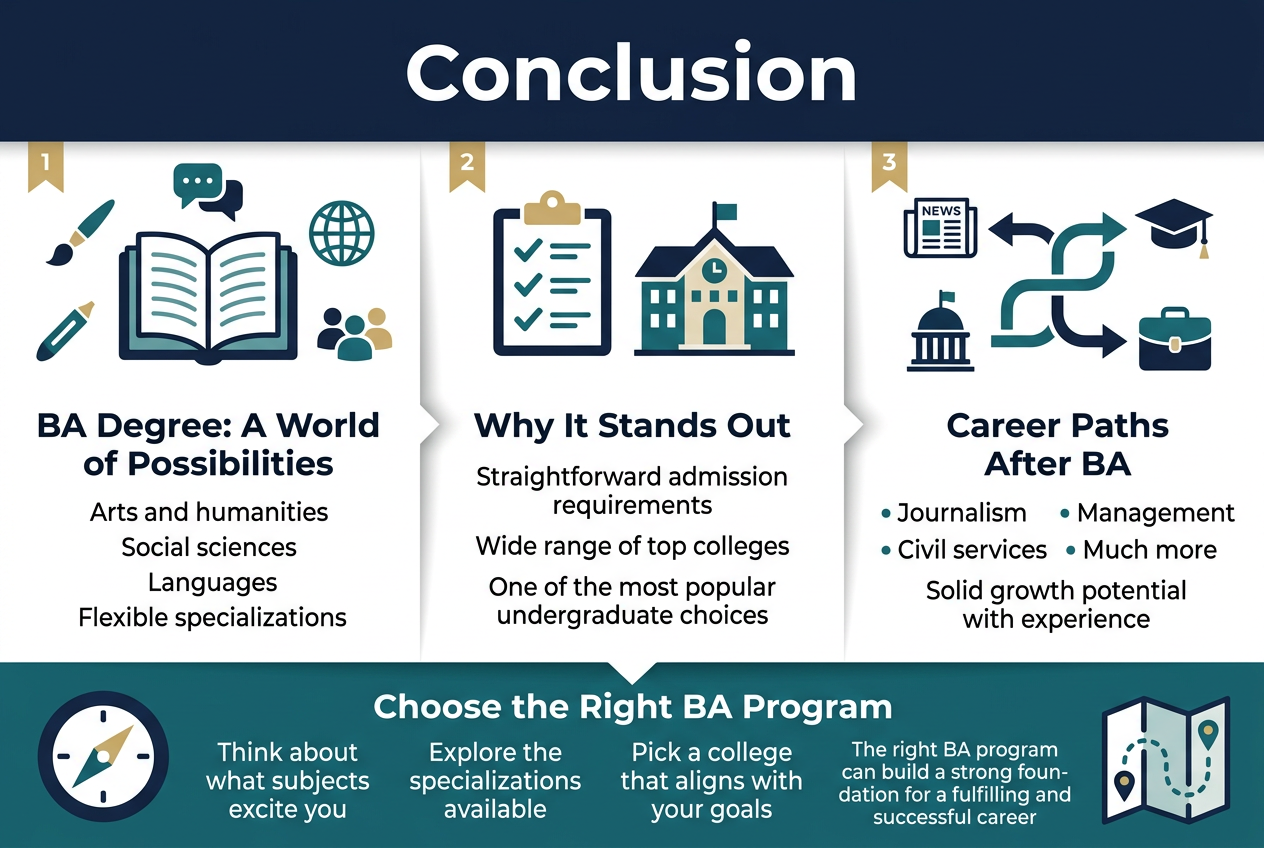
A BA degree opens up a world of possibilities, covering everything from arts and humanities to social sciences and languages. With flexible specializations, straightforward admission requirements, and a wide range of top colleges to choose from, it remains one of the most popular undergraduate choices for students across the country. The career paths available after completing a BA are genuinely diverse, spanning journalism, education, civil services, management, and much more — with solid growth potential as you gain experience.
If you are figuring out your next step after high school, a BA degree is absolutely worth considering. Think about what subjects excite you, explore the specializations available, and pick a college that aligns with your goals. The right BA program can lay a strong foundation for a fulfilling and successful career, so take your time, do your research, and make a choice that feels right for you.

Leave a Reply